It is not unusual for people who come to live in the Western states to acquire books about their new home. Fortunately there are many wonderful writers willing to interpret what it means to be part of this land and how to love it properly. The four books here are at the top of my stack. Their yellowing pages are crossed with underlining and their covers are creased and ragged, all signs of repeated readings. If you are meeting any of these writers for the first time, you youngish readers, I envy you your first acquaintance.

Where the Bluebird Sings to the Lemonade Springs : Living and Writing in the West by Wallace Stegner c1992
Frightening signs warning you of blinding dust storms and severe weather greet you on your first trip between Salt Lake City and Boise. There are few trees to seek shelter under out there beyond Rattlesnake Pass. The hills go on for miles and miles. It takes some time for an Easterner to learn to appreciate the openness. Here are the author’s words:
“You have to get over the color green; you have to quit associating beauty with gardens and lawns; you have to get used to an inhuman scale.”
From, “Thoughts in a Dry Land” included in Wallace Stegner’s collection of essays which make up “Where the Bluebird Sings..” The western landscape is not friendly, but people come from all over the world to walk around in it. They are not prepared for the heat or the lack of water. They frequently don’t take warnings from locals seriously. In some places that might cause inconvenience, out here, it can be deadly. Life is defined by the sparseness of water in the West. John Wesley Powell warned about it early on, but we don’t seem to be listening. Reading Wallace Stegner is going to help you get over the color green, and teach you indispensable truths.
The author’s words: “If there is such a thing as being conditioned by climate and geography, and I think there is, it is the West that has conditioned me. It has forms and lights and colors that I respond to in nature and in art. If there is a western speech, I speak it; if there is a western character or personality, I am some variant of it; if there is a western culture in the small-c, anthropological sense, I have not escaped it. It has to have shaped me.” It is these built in sensibilities that make Stegner’s the strong voice for thinking realistically about the West that his became.
There are personal stories of Stegner’s family, his “Letter, Much Too Late” to his mother is heart breaking and lovely. He writes about the western authors he admires. You will come away from this book with a longer reading list. If you want to learn about the real American West, Where the Bluebird Sings to the Lemonade Springs is a very good place to start.
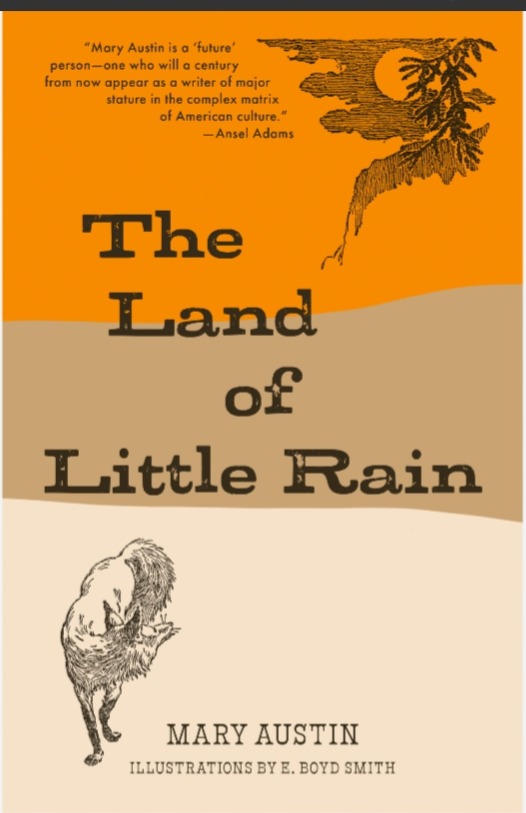
The Land of Little Rain by Mary Austin. First Published by Houghton, Mifflin and Company c1903. This edition Warbler Press Classics c2020.
No introduction I can give will beacon you in to read this book better than the authors words in her prelude:
“The real heart and core of the country are not to be come at in a month’s vacation. One must summer and winter with the land and wait its occasions. Pine woods that take two and three seasons to the ripening of cones, roots that lie by in the sand seven years awaiting a growing rain, firs that grow fifty years before flowering,–these do not scrape acquaintance. But if ever you come beyond the borders as far as the town that lies in a hill dimple at the foot of Kearsarge, never leave it until you have knocked at the door of the brown house under the willow-tree at the end of the village street, and there you shall have such news of the land, of its trails and what is astir in them, as one lover of it can give another.”
The desert region of which Mary Austin writes is the Owens Valley in California. It is surrounded by the Eastern Sierra Nevada and White Mountain Ranges. Death Valley and the Mojave Desert also make up the region. Her voice was one of the first to praise the beauty to be found in this desert, and to speak of the unusual animals and plants that manage to survive in such extreme aridity and heat. She includes stories about the human inhabitants, the Paiutes, Shoshones, Mexican and Chinese immigrants, miners, stagecoach drivers and others who eke out a precarious existence in this very dry land. Nobody else has described the desert who has had such a close and affectionate acquaintance with it. Her words are illuminating and poetic, old fashioned and painstakingly descriptive. You forget you are reading a work of non-fiction when you enter Mary Austin’s world.
The author’s words:
“The shape of a new mountain is roughly pyramidal, running out into long shark-finned ridges that interfere and merge into other thunder-splintered sierras. You get the saw-tooth effect from a distance, but the near-by granite bulk glitters with the terrible keen polish of old glacial ages. I say terrible; so it seems. When those glossy domes swim into the alpenglow, wet after rain, you perceive how long and imperturbable are the purposes of God.”
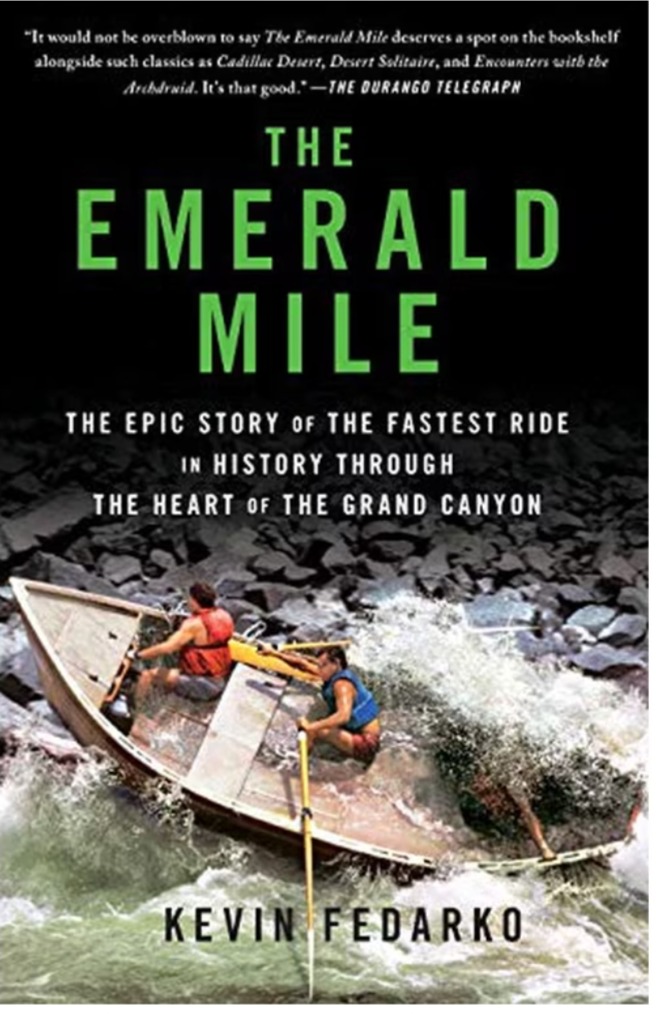
The Emerald Mile by Kevin Fedarko c2013 Scribner / Simon and Schuster : New York
Here comes the “occasionally very wet” part of today’s story. In 1983 a massive snowpack in the Rockies melted too quickly and floodwaters threatened to take out the Glen Canyon Dam and drown everything downstream with the entire contents of Lake Powell. Plywood flashboards atop the dam were holding on, for the moment.. While federal officials were busy figuring out what to do next, three Grand Canyon river guides launched their wooden dory The Emerald Mile into the wildest ride imaginable down the ferociously churning waters of the Colorado River. There are Youtube videos of that river in 1983 showing where beaches used to be, and wreckage of river running boats that didn’t get out of the way in time.
Kevin Fedarko tells this true story with all the facts and all the excitement in a well paced tale of adventure and natural forces out of control. All the people involved have their moments, and the reader is taken along on a very, very wild ride. It is history and legend combined for people who remember and for the grandkids who ought to know this story.

The Whistling Season by Ivan Doig c2006 Harcourt Books
As much as I usually don’t like the film versions of books I have loved, I can’t help saying that if anyone asked me, this would be THE book I would choose to make it to the big screen. Montana requires a big screen already. This is the story of a Marias Coulee, Montana homesteading family in 1909. The narrator Paul, his brothers Damon and Toby, and their father are living and housekeeping as best they can in the first year since their beloved wife and mother; Florence Milliron died. When the other students at their one-room school find out that Father has hired a housekeeper, name of Rose Llewellyn, to travel to Montana and take on the household chores, there is no end to the teasing and speculation about this new arrangement.
Ivan Doig creates characters so real and memorable you think you must have known them yourself. The main character Paul as an adult school superintendent is tasked with closing down the one-room schools in his territory. He looks back on his years in just such a school with fondness, humor, and a spot-on depiction of school age children in their training-up state. There are bullies and tattle-tale girls, fights, smart students, slow students, and a small girl who has to ride five miles to school with no companion but her horse. The Milliron household is about to change with the arrival of Rose Llewellyn and a few surprises. You do not need to be a fan of historical fiction to appreciate this book. Times change, but authors who can treat the human condition with understanding and clever storytelling never go out of style. This is one of Ivan Doig’s most loved novels. Join the fan club.
 Miss Tobey's Reading Room