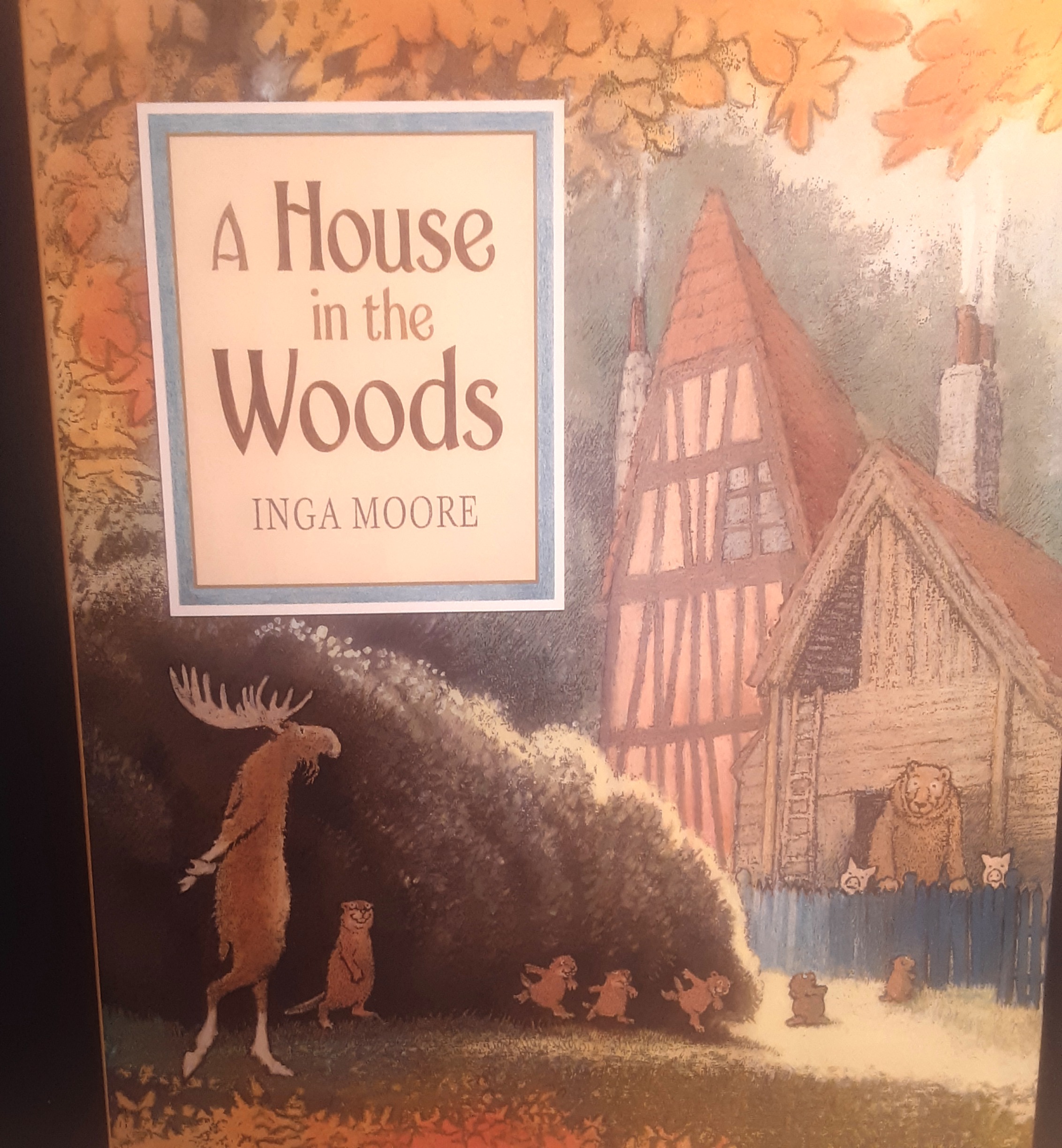
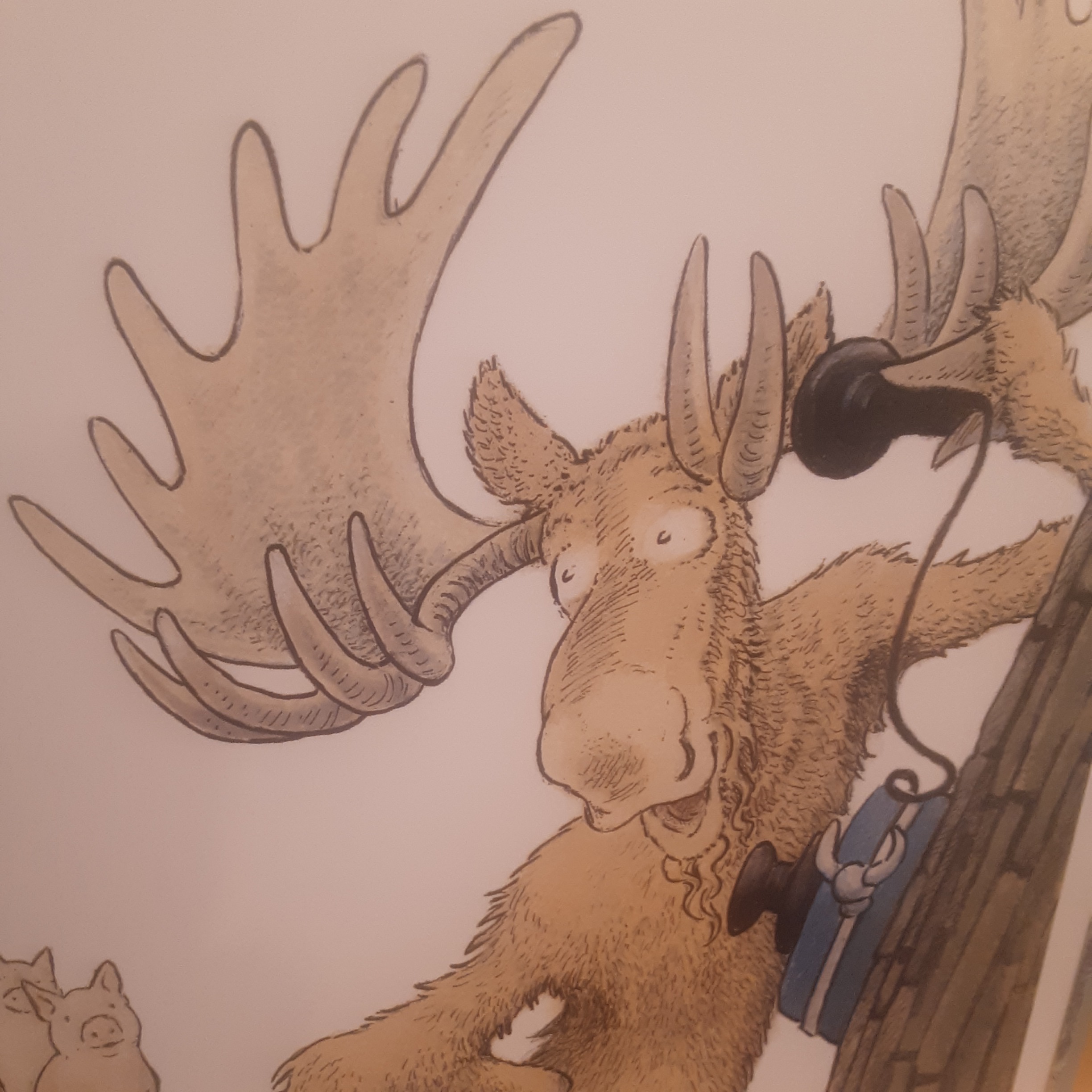
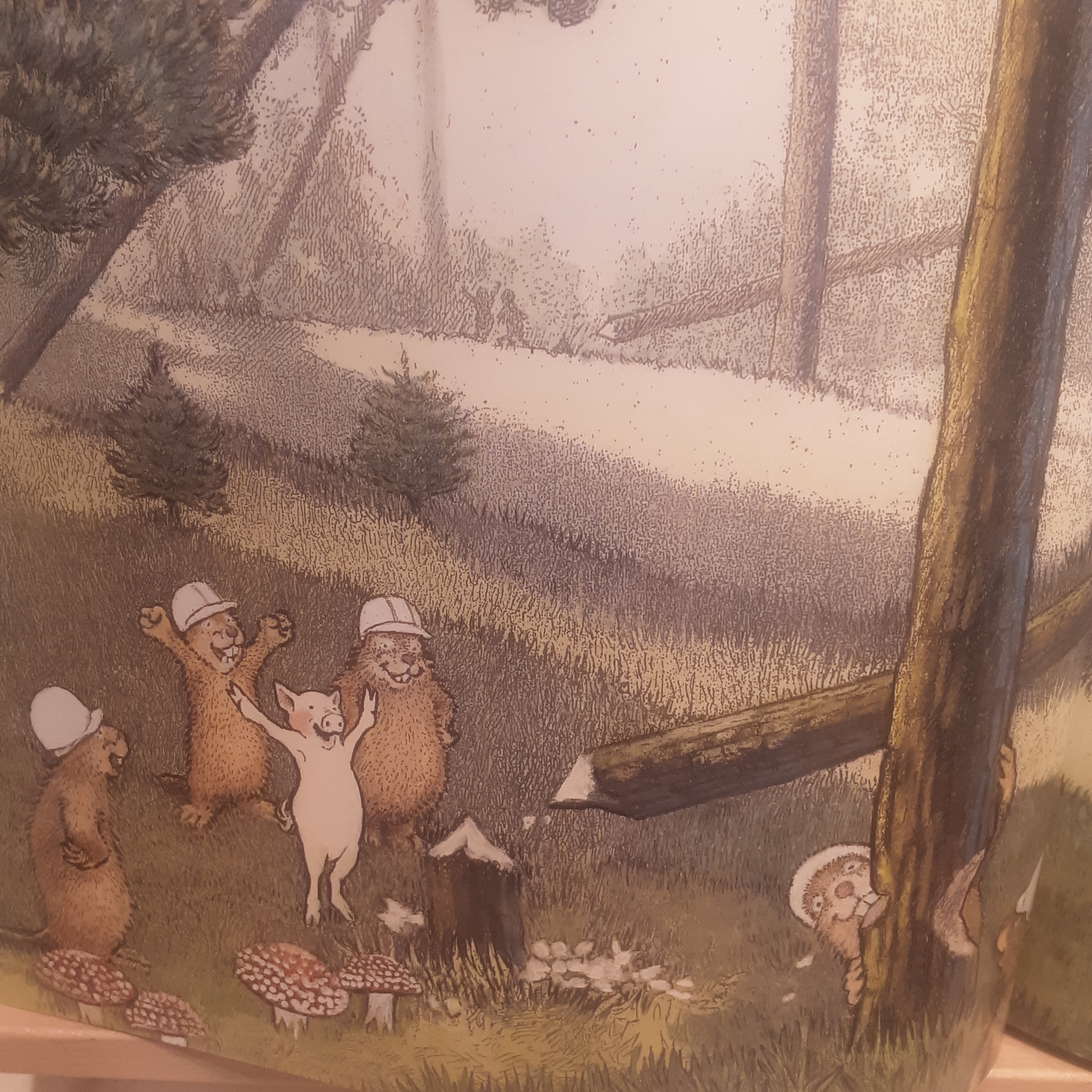
Many Moons by James Thurber c1943 Illustrations this edition c1990 by Marc Simont
This post dedicated to Mary Harrington, librarian and well read friend of great intelligence and imagination who once looked up at the mention of James Thurber and said, ” Ah, a surfeit of raspberry tarts.”
The princess Lenore has taken to her bed due to the above mentioned overindulgence in raspberry tarts. Her father, the King is summoned to her bedside and promises her the moon if she will only get well again. How is this promise to be kept? The Royal advisors and experts have many lists of facts and statistics that are mostly unbelievable and not in the least helpful. Their suggestions will only make matters worse for the princess. Fortunately, there is someone in the castle who knows how to solve problems, and it is not who you might expect….
This book is best appreciated by listeners and readers ages 7 to adult. It is a tad longer than most picture books, and there needs to be enough life experience in the audience to get the cleverness and humor James Thurber provides. I read it to students in grades 3-5. You can find editions with the original illustrations by Louis Slobodkin, which is the one I knew as a child. Marc Simont knew and worked with James Thurber, and his wonderful artwork for this story was approved by Rosemary Thurber. Both artists got it right!
Now for younger listeners:
May I Bring a Friend? by Beatrice Schenk De Regniers. Illustrations by Beni Montresor c1964 This edition Aladdin Paperbacks c1989
The authors words:
“The King and Queen Invited me to come to their house on Sunday for tea.
I told the Queen and the Queen told the King, I had a friend I wanted to bring.”
And what friends turn up! There is much merriment and fun each day of the week at the castle as all sorts of animal friends come to the party. This rhyming story will amaze and happily entertain preschool children. Suspense keeps young listeners eyes glued to the book as each page turn reveals the next surprising visitors. This story was always a hit with the 4-year-olds in the story time circle.
Stay by Kate Klise Illustrated by M. Sarah Klise c2017 Feiwel and Friends : New York
Eli has been Astrid’s companion and best dog since she was a baby. Eli watched out for Astrid, slept on her bed, ate with her, and shared her busy days. As time went on Astrid began to notice that Eli was growing into an elderly dog. She decided to savor all their favorite activities, and perhaps add a few new ones to a Bucket List for Eli.
This was a book I shared with first graders, and it usually got rapt attention. Everyone wanted to comment about a dog they owned or knew about. It is a gentle choice to introduce the topic of aging pets to young children. There are suggestions, both touching and amusing, of things one might do to enjoy time with the mature family dog.
Big Cat, Little Cat by Elisha Cooper c2017 Roaring Book Press : New York
Once there was a cat who lived happily as the only pet, watching the bird feeder, resting on the couch, giving itself a little grooming now and then. When a kitten arrived one day, the big cat began to teach it everything a cat must know, when to drink, when to rest, how to be. Time passed and the big cat got old and was no longer there. Perhaps a new little cat will come and need friendship and training from the now fully grown big cat.
This Caldecott Honor Book is perfect for the youngest children in a home with pets. The hard part of losing a pet is softened with this hopeful story about generations and new beginnings. The black and white illustrations clearly and simply evoke the daily activity and contentment in the life of a cat. It is a life-affirming story beautifully done.
Here are five books where the story takes place on a Northern island. There are no tropical breezes, only cool, blustery Atlantic weather and shorter days. It is time to think about summer reading, and these titles will help to while away quiet afternoons or evenings when the lawns are mowed, dishes are washed, and a book is just the thing. As every good fiction reader knows, characters that land on an island must be about to have an adventure, with or without pirates….
Katie Morag and the Big Boy Cousins by Mairi Hedderick c 1987 Random House Children’s Books : London This edition printed by Red Fox Books in 1999.
Katie Morag’s grandmother, who is known on the Isle of Struay, Scotland as Grannie Island, has invited a batch of Katie’s boy cousins for a visit. The cousins are full of mischievous pranks and out-of-bounds behavior that make the other islanders dread their annual appearance. Katie, however, is looking forward to some fun. How will Grannie Island handle this wild bunch?
Mairi Hedderwick paints the skies, sandy beaches, and small villages of an island in the Inner Hebrides for young readers. The Isle of Struay is based on the actual Isle of Coll. There are more adventures with Katie Morag to be had for readers ages 5-9.
Pinky Pye by Eleanor Estes c1958 This edition Odyssey Classics by Harcourt printed in 2000 with original illustrations by Edward Ardizzone
The Pye family, including their famous dog Ginger and smart cat Gracie are headed off to Fire Island for the summer. Father Pye, a renowned ornithologist, has been asked by Washington to investigate the very unusual sighting of a puffin by a reliable bird watcher on Fire Island. The bird watcher agrees to rent a cottage to the Pyes for a reasonable price, so Mr. and Mrs. Pye, Jerry age ten, Rachel age nine, their small Uncle Bennie age three, their pets, and piles of luggage are soon waiting for the ferry that will take them to the island.
Soon after their arrival the Pyes add a kitten named Pinky, for her raspberry pink tongue, to the family. Pinky is the only cat ever known to possess the ability to type. Her messages are some of the best parts of the book.
The authors words: As typed by Pinky… ” The String Bean Game”
a. This important game HAS to be played with someone.
b. Go to the icebox , sit in front of it, say “Woe,” and Pye, or whoever you own will come. Pye will understand what you want, for you will have the eager string bean game expression on your face.
c. Now, crouch and wiggle This means you are ready for the throw.
d. Now. He throws Bean. Tear after it as though you have been shot out of a cannon. People are always surprised to see how fast you can get going without having to gather speed. Never let speed be ungathered. Race after Bean, bring it back and lay it at Pye’s feet. He throws Bean again. Race after it again. and if it has gone around a corner, knock recklessly into a wall as you make the speedy turn. Pick it up and trot back with it……….”Hurray!” the people will exclaim noisily. “She retrieves like a dog!” What nonsense! Dogs retrieve like dogs—huff, huff, pant. Cats retrieve like cats and bring variety to the game.
There is a mystery to be solved among other island events. Gracie the cat wants very much to gain entrance to the eaves to investigate. Everything that is good in a middle-grade book exists in this summer story. Give it a try.
Seacrow Island by Astrid Lindgren. c1964. This edition published 2016 by Oxford University Press
The author’s words:
“If you go down to the quay in Stockholm on a summer morning and see a little white boat called Seacrow I lying there, that is the right boat to take and all you have to do is to go on board…….She crosses wide expanses of open water and steams through narrow channels, past hundreds of green islands and thousands of grey, bare rocks. She does not go fast and the sun is low when at last she reaches the quay at Seacrow Island. She has no need to go any further, for there is only the open sea beyond with its bare rocks and its islands where nobody lives except eider ducks, gulls and other sea birds.”
The Melkerson family is on their way to summer at a place they have never been before. Melker, the father, has rented a cottage sight unseen because he liked the name Seacrow Island. His family consists of Malin, his nineteen-year-old daughter and three sons, Johan, Niklas, and Pelle. Pelle is the youngest and he is seven. Will the unknown Carpenter’s Cottage turn out to be cozy? What is there to do on such a remote and quiet island? The Melkerson’s adventures are about to begin as they learn about sailing, fishing and the wildlife all around them. Ever since their mother died, the brothers hope that the young men who fall in love with Malin every quarter hour will not marry her and take her away. She is the support and heart of the family. New friends and interesting characters are always to be found in a story by Astrid Lindgren. This book has been a favorite in Sweden for generations of readers.
Pine Island Home by Polly Horvath. c2020 Holiday House
The adults in the lives of the McCready sisters have selfishly and thoughtlessly allowed themselves to be carried off by tsunamis and heart attacks, leaving the girls orphaned and alone. Fiona fourteen, Marlin, twelve, Natasha, ten, and Charlie, eight, have been raised in a missionary family and have learned to adjust to living in all sorts of places, but now they face new challenges at their Aunt Martha’s farm on an island in British Columbia, Canada. Fortunately Aunt Martha left them the farm, money, and a kitchen fully stocked with food, and even enrolled them in the local schools. The sisters are determined to hide the absence of a responsible adult from Social Services because they fear being separated. After all they have been through, that would be unendurable.
The McCready girls are a match for difficulties that would defeat less talented and intelligent children. Fiona makes a deal with cranky neighbor Al Farber to pose as their guardian in exchange for hot homecooked meals prepared by Marlin who is quickly becoming a proficient cook. The story of how the girls learn to cope is the main theme of this story, the island location is secondary. Helpful adults do turn up, and the strong bond between the sisters is reassuring. Tune in to the sequel, “Pine Island Visitors” for more Polly Horvath magic.
The Summer Book by Tove Jansson c1972 This edition published by The New York Review of Books in 2008.
This one is for the grown-ups. The setting is a tiny island in the Gulf of Finland. Six-year old Sophia, her father and grandmother are sharing a small cottage for the summer. There is no plot to follow, just the passage of a season on the island. Each chapter is a slice of life episode with weather, nature, an occasional visitor, and conversations between the child and her grandmother as the main events. Sound too quiet? Here are the authors words about a tremendous storm that broke as the family were fishing away from their own island:
“Papa broke the padlock on the door with a big stone. He did it to save his family. ……………….The walls of the house trembled steadily with the thundering of the sea, and it began to get cold. Spume from the breakers covered the windowpanes and ran over the sill and across the floor. Every now and then Papa would get up and go out to see to the boat.
The seas breaking against the sheer outer side of the island had grown. One after another, the waves rose up in their white immensity to a tremendous height, and foam hissed against the rocks like the blows of a whip. Tall curtains of water flew across the island and sailed on west. The storm was titanic!”
Islanders do not always welcome those who build large new houses that mar the view. Here are the author’s words when Sophia and Grandmother get caught checking out the new neighbor’s island and are invited in:
“Don’t look so cross,” Grandmother whispered. “This is socializing and you have to learn how to do it.” Malander came back with bottles and glasses and put them on the table. “Cognac, he said. “And whiskey. But I’m sure you’d rather have a lemonade. “I’m very fond of cognac,” Grandmother said. “A small glass and no water, thank you. Sophia? What would you like?”
“The other!” Sophia hissed in her ear. “Sophia would prefer a lemonade.” Grandmother said, and thought: We’ve got to teach her some manners. We’ve made a mistake. She has to spend more time with people she doesn’t like, before it’s too late.”
Sophia and her Grandmother talk about life, death, heaven, hell, and what happens when an angleworm gets cut in half. They build a miniature Venice, trade a cat that kills birds for a boring, soft lap cat, and have arguments. You are given the flavors, scenery, and essence of a Northern Island to dwell in and remember after this slim book ends. I recommend a second reading, maybe more.
The Royal Palace in Paris was holding its Grand Contest of Art and all the great painters had works to exhibit. Gaston du Stroganoff, Felicien CaffayOllay, Alphonse LeCamembair and others are showing important paintings sure to win admiration from the crowds, and prizes from the judges. There was much consternation among the experts over a simple painting of a duck by an unknown artist. How ridiculous! People were saying this Clousseau has some nerve to waste the time and attention of serious art critics. The art world is soon to be astounded because Clousseau’s duck can quack! What will happen as more and more of his lively paintings are purchased and displayed?
The Incredible Painting of Felix Clousseau by Jon Agee c1988 Farrar, Straus & Giroux
Books by Jon Agee are always full of surprises. More of his titles will appear here because they are such fun to read and you can count on a joyful response from any audience you share them with. If you want to convince a child that reading is a pleasant activity, this book will do the trick.
How to Talk About Books You Haven’t Read by Pierre Bayard. c2007 Published in the US by Bloomsbury USA Translated from the French by Jeffrey Mehlman
This was not the book I meant to talk about this week, but during a long overdue dusting, sorting and culling of my books, this one fell out on my foot. I don’t remember when I bought it, and somehow I had not read it. It was love at second sight! I still remember the day I was treated to a shocked silence in the bookstore where I worked, when I admitted to a co-worker that I had not read Ulysses by James Joyce. “But, it is a seminal work!”, I can hear the tone yet! I am sorry, people in Dublin, but after that I have been determined NOT to read it. You have a list in your head of books that you “should” have read but haven’t. Do you think that list will be posted on your gravestone? Mr. Bayard will set you free in this discussion of our current reading culture and how to navigate social or professional literary conversations around books you have not read or have forgotten.
The author’s words:
“There is a tacit understanding in our culture that one must read a book in order to talk about it with any precision. In my experience, however, it’s totally possible to carry on an engaging conversation about a book you haven’t read—-including, and perhaps especially with someone else who hasn’t read it either.”
“If we wish, then, to learn how to emerge unscathed from conversations about books we haven’t read, it will be necessary to analyze the unconscious guilt that an admission of non-reading elicits. It is to help assuage such guilt, at least in part that is the goal of this book.”
Analyze and assuage he does. Mr. Bayard is a literature professor and a psychoanalyst. His book is full of examples of types of non-reading from famous writers, ideas to ponder, and strategies to help you speak about books you haven’t read without shame.
Oscar Wilde, as quoted in the front of the book: “I never read a book I must review; it prejudices you so.”
Goodnight Moon by Margaret Wise Brown c1947 Harper & Row
While visiting a book store to see what books for the very young are readily available, I came across this old friend that has sent generations of children off to sleep. We always kept copies of ” Goodnight Moon” and its companion books” The Runaway Bunny” and “My World” available in our book fairs for anyone needing a baby gift.. Margaret Wise Brown left an indelible legacy with her gentle bedtime stories. It seems that no nursery is completely furnished without Clement Hurd’s familiar bright book cover on a shelf.
I Just Want to Say Goodnight by Rachel Isadora c2017 by Nancy Paulsen Books / Penguin Young Readers
Travel now to a village on the African veld, where Lala is deaf to her mother’s call that it is time for bed. Lala is not ready to sleep. She must say goodnight to a cat, a goat, anything to put off the inevitable. Sleep objectors at your house will appreciate Lala’s delaying tactics. Parents will love reading this many times, which is also inevitable.
Uncluttered and colorful illustrations bring an African evening to life for drowsy youngsters. There might be something familiar about Lala’s choice for a bedtime story, but don’t tell!
The House In the Night by Susan Marie Swanson, pictures by Beth Krommes c2008 HarperCollins
A first reading list, this one featuring board books for the youngest readers is in the works for the Reading Room. There will be more bedtime stories including the one pictured above. The list will appear as a page on the site in the next few days. Next week, another book for those who may stay up past eight.
Can you entertain anyone with a book consisting entirely of simple colored dots? Turns out you can, uproariously. Press Here is a participation book that has to rank as one of the most imaginative concept books ever created. Readers touch the colored dots on a page, turn the page, and magic happens. The dots multiply, slide over the pages, and change as the reader presses, tilts, or shakes the book. All without batteries!
Shake a book with straight lines of colored dots and see what happens!
This book is a counting book, color book, a primer for following directions, and a book that will be requested by your young listener again and again. If you read it at bedtime, sleep will be delayed considerably. It is a sturdy book with a board cover and tough pages to withstand many readings. This book has been a huge seller. It is a perfect gift book for families with toddlers, and anyone facing a long plane ride with young children. I have shared it with children of all ages, and adults find it very cool too.
Herve Tullet has continued to create clever, screen-free wonders for your children. Check them out soon.
The 500 Hats of Bartholomew Cubbins by Dr. Seuss Originally Published 1938 by Vanguard Press, Inc. This edition c1965 Published by Random House, Inc
It was a normal Saturday morning in the Kingdom of Didd, as King Derwin headed into town. It was equally normal for young Bartholomew Cubbins as he set off to town to sell his basket of cranberries. That all changed when Bartholomew was unable to honor the king with a bare head. He was willing to take off his hat, but something very odd and mysterious happened when he did. King Derwin was definitely NOT amused, and Bartholomew is wisked off to the palace under arrest.
Dr. Seuss was telling stories that defied authority and boring normalcy long before the Cat in the Hat came on the scene or Horton hatched anything. Generations of young readers have followed Bartholomew Cubbins through his exciting and frightening visit to the palace of the Kingdom of Didd. What happens in palace or castle is always of interest to us of humble origin. Here is the first of a series of books that listeners have loved and that begin with:” Once upon a time there was a princess, or a king, etc”. There is a reason this book has stayed in print all these years. If you happen to be the first one to read it aloud to some young listener, prepare to be appreciated. Thank you, Dr. Seuss.
” The Elephant’s Child” from ” Just So Stories” by Rudyard Kipling originally published 1902. This edition Puffin Classics c2016
The Author’s Words:
“By and by, when that was finished, he came upon Kolokolo Bird sitting in the middle of a wait-a-bit thorn bush, and he said, ‘My father has spanked me, and my mother has spanked me; all my aunts and uncles have spanked me for my ‘satiable curiosity; and STILL I want to know what the Crocodile has for dinner!’
Then Kolokolo Bird said, with a mournful cry, ‘Go to the banks of the great grey-green, greasy Limpopo River, all set about with fever-trees, and find out.’ “
The Elephant’s Child had only a short, blackish, bulgy nose, and he left an untidy trail behind him of items he dropped because he had no way to pick things up. How he meets a crocodile and is given a new, much more useful appendage is a favorite Just So tale.
For richness of language, Kipling is your man. Has anyone enjoyed playing with words or reveled in the sounds of words more? “The Elephants Child” is fantastic fun to read aloud. Kipling’s words roll off the tongue, and adhere to the brain. I have had “The great grey-green, greasy Limpopo,etc.” phrase floating around in my mind since I first heard the words read aloud by my fifth-grade reading teacher. With a Kipling-enhanced brain, one can drift away to wonder what fever-trees look like and imagine the Bi-Coloured-Python-Rock-Snake and his scalesome, flailsome tail. There are picture book versions of this story, but perhaps something is lost if the listener is distracted from the charm and inventiveness of the language.
Reading the “Just So Stories” is reading for the ear. The listeners you share them with are introduced to poetry, exotic words and locations, and of course, all the fabulous origin stories. Try “The Sing-Song of Old Man Kangaroo” and “The Cat Who Walked by Himself”… “The wildest of all the wild animals was the Cat. He walked by himself, and all places were alike to him.”
The Golden Plate by Bernadette Watts c2014 NorthSouth Books Inc.
Elizabeth had a beautiful Doll’s House. It had a tiny telephone table with a tiny telephone. It had every convenience a doll might want and many elegant extras. One of these was a golden serving plate. Isobel, who lived nearby, enjoyed playing with Elizabeth and her Doll’s House. Isobel’s own dolls had to make do with a serviceable home made out of a bookcase. Perhaps it could use a tiny update, so, after a visit to Elizabeth’s house, the golden plate left in Isobel’s pocket. It began to feel heavy on her walk home….
You will find many of Bernadette Watt’s books in the j398.2 section of your library. Her renditions of well known folk and fairy tales are lovingly illustrated with dreamy colors and lots of details for a child on your lap to study. Her work shows a deep appreciation for beauty. Probably there will be another post featuring her “Three Little Pigs”, “Bremen Town Musicians” and others. Today we celebrate one of her original stories. “The Golden Plate” is a gentle and sensitive handling of covetousness. It is a good one to read to your class after a dispute over property. It might also serve as a preventative! The solution to Isobel’s problem and kindness of the characters in this story were satisfying to my first grade listeners. I had a stack of possible titles to share this week, and this one kept creeping into my thoughts. Check your local library for a copy to read to any 5-to-8-year-olds at your house.