Three Adventures from the overloaded shelves…
Leaving Home
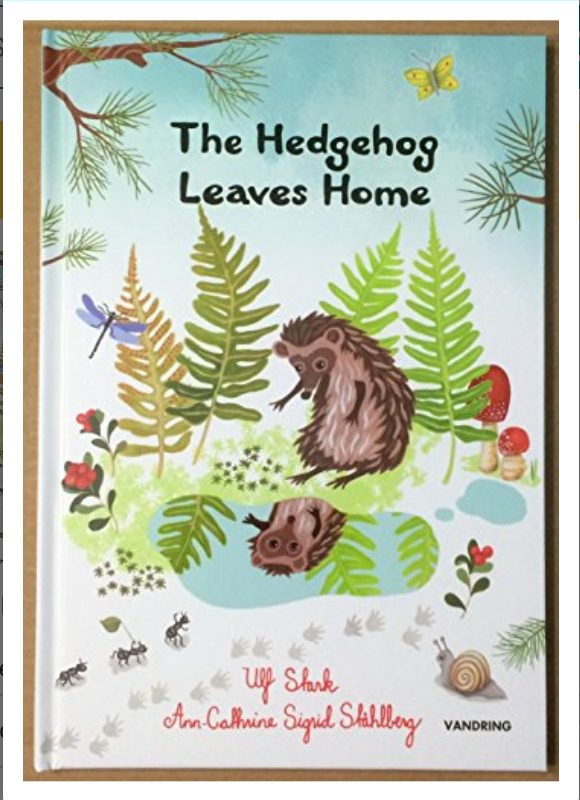
The Hedgehog Leaves Home by Ulf Stark Illustrated by Ann-Cathrine Sigrid Stahlberg c 2011 by IKEA Family / Vandring
It is always a bit embarrassing to discover an author new to you who has written 30 or more books, but it is also good news if you find you like what they write. Ulf Stark is new to me this year. I think his voice is uniquely down-to-earth and engaging. Listen to his words as he starts off Hedgehog’s story:
“All of a sudden, fall arrived. The leaves on the trees turned yellow and red. Mushrooms pushed up and out of the ground. And it grew colder day by day.
“You are big enough to make your own way in the world now,” said the hedgehog’s mommy, giving him a kiss. “Just watch out for all the dangers in the big wide world.”
“I will,” said the hedgehog.
“And learn as much as you can.”
“I will,” said the hedgehog. And off he set into the forest to find a place to sleep for the winter.”
The story is simply launched, and young hedgehog begins to learn useful things along the way to growing up. He learns that rolling down a hill is fun. He learns which foods are safe to eat and to his taste, and that swimming is not for him. He learns to watch out for foxes, but that there are friends out there who will help you. This is a gentle and encouraging story for any young growing-up people in your household.
Going Home
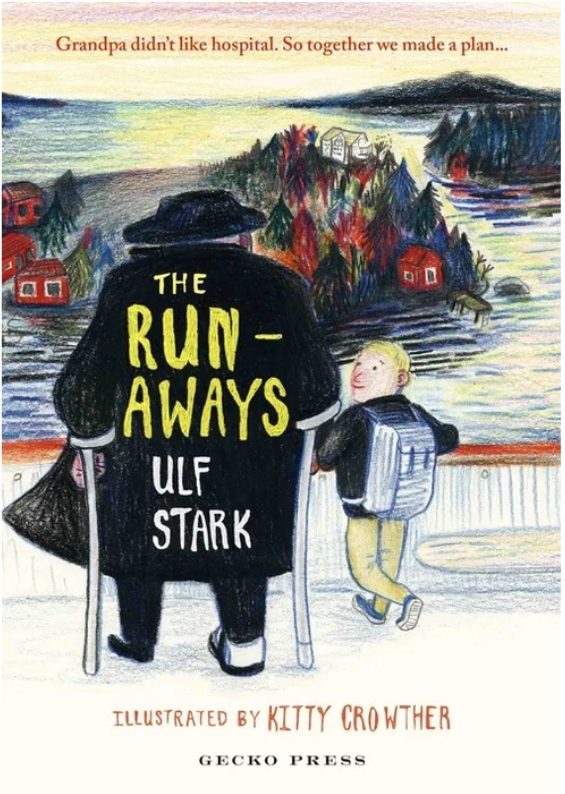
The Runaways by Ulf Stark Illustrated by Kitty Crowther c2018 Gecko Press : Wellington, New Zealand
Gottfried Senior is in the hospital and he is not pleased in the least. He is difficult, spits out the pills to make him calm, and yells at the nurses. The author’s words:
“I’m shut in here like an animal!” he shouted. “What do you think I am? An ape?”
His face turned bright red and he swore, so Dad and I had to cover our ears. Dad thought I didn’t need any more swear words than the ones I already knew. I disagreed.”
All that Grandpa senior wants is to make one last trip to the house where he shared so many happy years with his wife. His grandson, Gottfried Junior, is the only one willing to help Grandpa get his wish.. He hatches an elaborate plan, which includes deceiving his parents into thinking he is attending football practice and finding an accomplice to supply an adult voice and pose as a football coach. Young Gottfried does ask the question, “Was it wrong to lie when it made everyone happy?”
This is not a story to encourage children to run away from home and use unacceptable language. The Runaways is about having grandparents who might be difficult and some reasons why, without TOO many specific details. Running away or lying to your family are usually not the best choices, since the author warns, “You have to think of everything!” This is an honest and gently humorous book that helps with understanding and being ready when it is time to say farewell to a beloved grandparent.
Flying Away
The Land of Green Ginger by Noel Langley Illustrations by Edward Ardizzone c1975 This edition published by David R. Godine : Boston c2007.
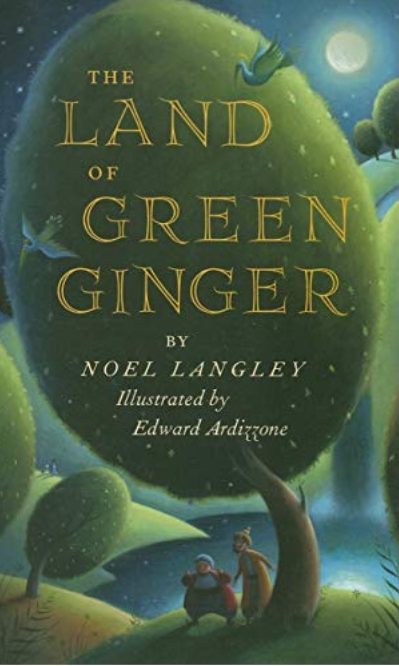
The Land of Green Ginger is a magical floating island, “sprinkled with ginger trees laden down with branch upon branch of sparkling sugar-coated green ginger; and big bright beauteous flowers grew out of the soft velvety grass, and water-lilies floated on a cheerful little hubblebubbling stream. It was all charmingly rural. No bits of paper, no empty bottles, no initials carved on the tree trunks. You cannot imagine such natural wonders, gentle reader; you must simply take my word for it.”
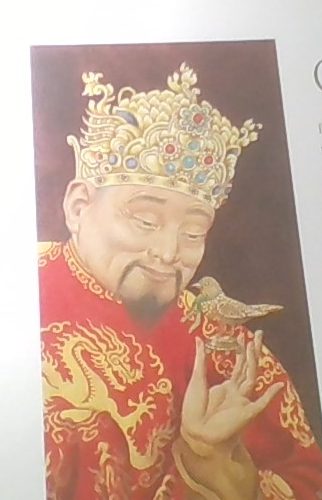
Abu Ali, The son and heir of Aladdin, the Emperor of China, could talk as a day-old baby and upset the Queen Mother, who thought she heard herself referred to as a Button-Nosed-Tortoise. “I understand you called the Queen Mother a Button-Nosed-Tortoise?” inquired the Emperor.
“That’s not quite true,” replied the Son and Heir politely, “I only said she had a Face Like One.”
Abu Ali does turn out to be a well-mannered young man destined to search for the Land of Green Ginger, reverse the spell on a magician who accidentally turned himself into a button-nosed-tortoise, and rescue the beautiful Silver Bud from an unhappy marriage. Of course the Genie of the Lamp appears in the story, along with a flying carpet and various helpful and a few crafty characters with bad intentions. Noel Langley’s sparkling comedic retelling makes this a wonderful story to read aloud. Mr. Langley co-wrote the screen play for The Wizard of Oz movie we all know and love. This book is really, really funny and you can hear the same tone and dialogue that helped make the movie a classic.
I have a copy of Langley’s Desbarollda the Waltzing Mouse, also illustrated by Edward Ardizzone. The writing is exquisitely witty. Edward Ardizzone seems to have done the pictures in so many beloved books. His drawings are sprinkled throughout The Land of Green Ginger and add much to the enjoyment. For anyone over age nine!